 AV ALL IN
A mosque sound system has one job: every worshipper should understand every word, in every row. In a hall full of marble, glass and a dome, that depends more on where the sound goes than on how loud it is. This guide explains what the system includes, how it is sized, and the mistakes that cause echo and feedback.
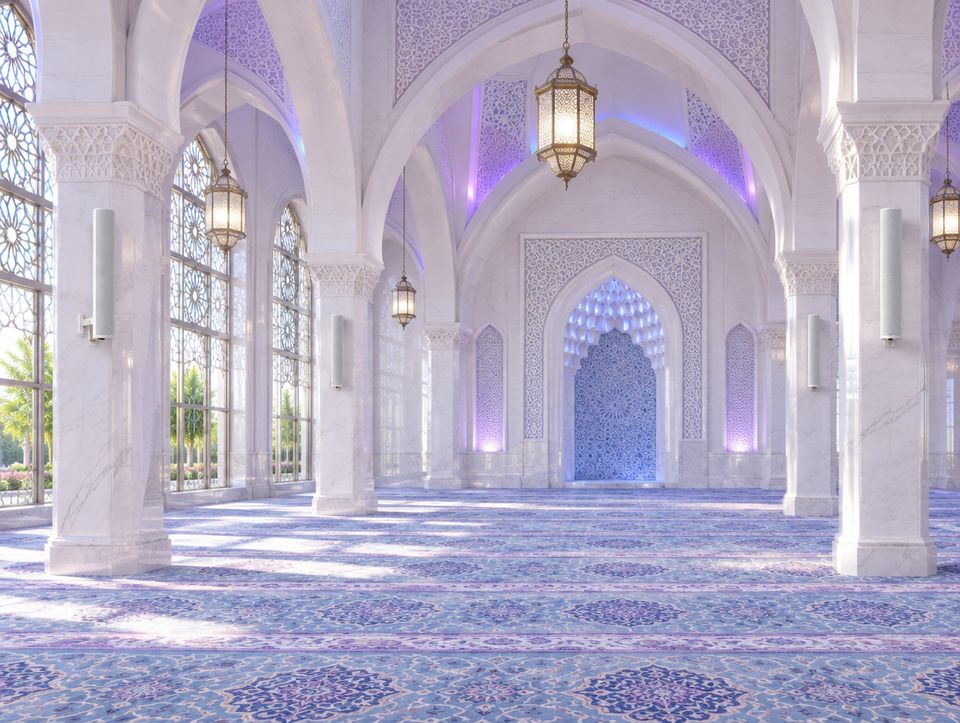
Why a mosque is a hard room for sound
Hard surfaces and high ceilings keep sound bouncing for a long time. Engineers measure this as reverberation time (RT60): the time a sound takes to fade by 60 dB. Clear speech needs roughly 1 to 1.5 seconds, and an untreated domed hall often has several seconds. When reverberation is long, each new word arrives on top of the tail of the last one.
Clarity itself is measured with the Speech Transmission Index (STI), on a scale from 0 to 1. A common design target for a speech system is 0.50 or higher at every listening position.
What the system includes
| Part | What it does |
|---|---|
| Microphones | A headworn or lavalier wireless microphone for the khutbah, a fixed microphone at the mihrab and one at the minbar. A microphone close to the mouth is the cheapest way to cut feedback. |
| Mixer and DSP | Mixes the microphones and applies equalisation, feedback suppression and delay. It stores presets for prayer, khutbah and lessons. |
| Amplifiers | Power the speaker lines. Long runs with many speakers normally use 100 V lines. |
| Column speakers | Tall, narrow speakers that keep sound in a flat beam aimed at the worshippers, away from the walls and the dome. They are the usual choice for a main hall. |
| Ceiling speakers | For low-ceiling areas such as side aisles, the women’s prayer area and basements. |
| Outdoor speakers | Horn speakers for the adhan, on a separate zone with its own level, set within local regulations. |
| Zone control | Separate volume for the main hall, the women’s area, the courtyard and the ablution area. |
How the system is sized
- Start from coverage, not from a speaker count. The goal is an even level across the prayer area, within about 3 dB from the first row to the last.
- Aim speakers at people. Every beam that hits a wall or the dome comes back as echo.
- Use more speakers at a lower volume rather than a few loud ones, so each listener is close to one speaker.
- Delay the speakers further back so their sound arrives together with the sound from the front: about 2.9 milliseconds for each metre of distance.
- Keep the speech level at least 10 dB above the background noise of fans, air conditioning and the street.
- Treat the room where the budget allows. Carpet absorbs high frequencies only. Absorbing panels on the rear wall and the lower side walls shorten the echo more than any equipment can.
Common mistakes
- Horn speakers inside the hall. They are built to throw sound far outdoors and sound harsh indoors.
- Loud speakers on the front wall only, so the front rows are deafened and the back rows hear echo.
- No delay on the rear speakers, which makes every word arrive twice.
- A distant microphone turned up until it feeds back.
- Buying equipment before anyone has measured or modelled the room.
What to prepare before asking for a quotation
- Length, width and height of each prayer area, and whether there is a dome.
- Floor, wall and ceiling finishes.
- Number of worshippers on a normal Friday.
- The zones you need: main hall, women’s area, courtyard, classrooms, outdoor adhan.
- Photos or drawings, and a list of any equipment you want to keep.
Questions people ask
How many speakers does a mosque need?
There is no fixed number. It follows from the area, the ceiling height and the reverberation of the hall. A coverage study places each speaker so that every row gets the same level, and that study decides the count.
Column speakers or ceiling speakers?
Column speakers suit high halls because they control how far the sound spreads upward. Ceiling speakers suit low ceilings, where each one covers a small circle of listeners directly below it.
Can an existing system be fixed without replacing everything?
Often, yes. Re-aiming the speakers, adding delay and equalisation through a DSP, and changing the imam’s microphone solve many complaints. The amplifiers and cabling can usually stay.
This guide is also available in Arabic.